
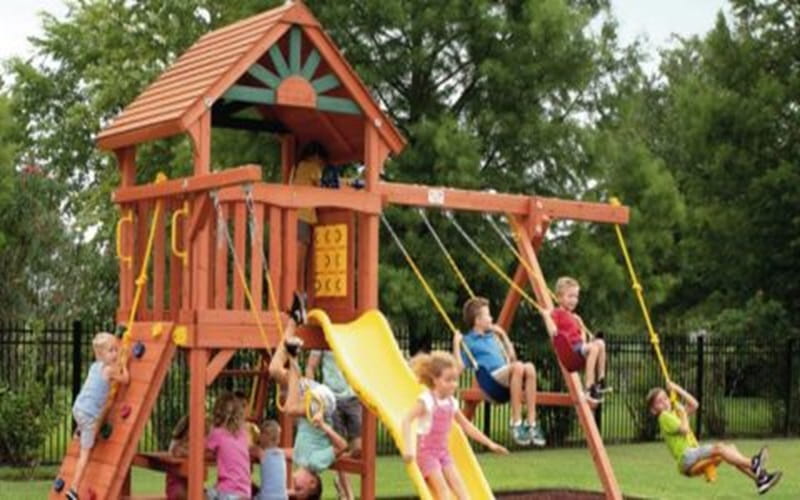
Buying a wooden playground is a bigger decision than it first appears. You aren’t just picking a couple of slides and swings — you’re choosing something your kids will climb on nearly every day for years, in all kinds of weather, often with a friend or two piled on at once. Get it right, and it becomes the backyard every neighborhood kid wants to visit. Get it wrong, and it turns into a wobbly, splintering chore you replace a few summers later.
This guide covers what actually matters when you shop: the material, the build, the safety of the swing set and playground, sizing, warranty, and installation. By the end, you’ll know what to look for in person and what to ask before you spend a dollar.
Why a Wooden Playground Beats Plastic and Metal
Most backyard playsets fall into three material camps — plastic/vinyl, metal, and wood — and they don’t hold up equally.
Plastic and vinyl sets look tidy on a showroom floor, but years of sun and heat tend to fade, crack, and warp them. They often carry lower weight limits, which matters more than parents expect once two or three kids are climbing at once, and damaged plastic parts usually have to be replaced rather than repaired. Metal sets heat up quickly in the sun and can rust and develop sharp edges over time.
Wood sidesteps most of that. Quality cedar and redwood are naturally strong, naturally resistant to insects and decay, and far cooler to the touch on a hot afternoon than plastic or metal. Wood also takes rough play in stride—climbing, swinging, jumping, all of it—and when a single component finally wears out, you can swap just that part instead of scrapping the whole structure. A wooden set also looks aesthetically pleasing in the yard, blending into the landscape rather than fighting it.
Material: Not All Wood Is Equal
Once you’ve settled on wood, the next questions are which wood and what grade.
Cedar and redwood are the two premium choices, and both are excellent. Cedar has a warm brownish tone and is prized for resisting warping; redwood carries a reddish tint and is similarly durable, usually at a slightly higher price. Left unsealed, both weather to a silvery-gray patina, so a little upkeep keeps them looking their best.
The detail many shoppers miss is the wood’s grade and whether it’s chemically treated. Cheaper sets sometimes lean on heavily processed lumber or chemical coatings to make up for weaker wood. The best sets use solid, naturally rot- and insect-resistant timber with no harsh chemicals — which matters when small hands touch every surface all day. Look for makers that source from certified mills practicing sustained-yield forestry, and ask whether any finish is a water-based, non-toxic, child-safe stain rather than a chemical pressure-treatment.
Construction and Safety
A great-looking set built poorly is still a poorly built set. Look closely at how it goes together:
- Solid beams and joints. Sturdy timbers and reinforced, multi-point joints keep a set from swaying. Notched support gussets add real strength where it counts. Best to avoid glued-together / laminated timbers.
- Recessed, corrosion-resistant hardware. Bolts and brackets should be recessed and rust-resistant — nothing protruding to scrape a knee, nothing that corrodes after a few rainy seasons.
- Rounded edges and smooth surfaces. These cut the risk of scrapes and splinters.
- Secure swings and climbing features. Protected slides, non-slip grips, and well-anchored swings keep play safe.
A good showroom rule of thumb is the “shake test” — grab a support beam and try to wobble it. A premium set built to adult standards shouldn’t budge, which also means a parent can climb up alongside the kids without a second thought.
Size, Layout, and Your Actual Yard
Before you fall for a set, measure your space. You need room not just for the footprint but for safe clearance around swings, slides, and climbing walls. As a baseline, the CPSC recommends a clear safety zone of 6 feet in every direction from stationary parts like slides and climbers — kept free of fences, walls, trees, overhead branches, clotheslines, and electrical wires — with extra room in front of and behind swings, since kids may jump from a moving seat. Pull each candidate set’s dimensions and recommended clearance and map them against your yard.
Yard shape matters too. Sloped and uneven lots are common, and a set should be leveled and fit to the grade rather than forced onto it. Some base styles handle this better than others: ladder-style bases with features like swivel tire swings, dual climbing ladders, and rope ladders tend to suit uneven or sloped yards, while fort-style bases can tuck a picnic table, playhouse, or sandbox onto the lower level. The right base depends on your terrain and how your kids like to play.
Build for the Kids You Have — and the Kids They’ll Become
The best playset grows with your family. Younger kids want lower swings and gentle slides; older kids want taller climbing structures, monkey bars, and a fort to call their own. Favor sets you can customize and expand — adding slides, rock walls, canopies, telescopes, steering wheels, and more — so the set stays exciting as your kids’ interests and abilities change. A modular set you can add to is one you’ll keep for a decade instead of outgrowing in two summers.
Warranties: Read What’s Actually Covered
Warranty terms vary widely, and the fine print is where the real differences hide. Watch a few things:
- What’s covered and for how long. Coverage commonly runs from a few years up to a limited lifetime on structural wood components, with shorter terms on accessories like slides, swing hangers, and ropes.
- Manufacturer vs. dealer warranty. Some coverage and support exist only at the dealer level. Know who you’ll actually call when you need a part.
- Local support. A warranty is only as good as how easy it is to use. Sets supported through a local showroom — parts in stock, claims handled in-house — beat waiting on an overseas manufacturer.
Installation and Maintenance
Some sets ship as DIY kits with lengthy assembly; others arrive professionally installed. If you’d rather skip a lost weekend (and the missing-hardware-bag headache), professional installation is worth it — especially since proper anchoring is essential to keep a set stable in high winds. With Tree Frogs’ white-glove service, a trained crew delivers the set, levels it on your actual terrain, assembles it, anchors it, and safety-checks it, often within about 7–10 days of purchase.
See Playgrounds in Person
A website can’t replicate watching your kids climb the actual set, or grabbing a beam yourself to feel how solid it is. That’s the real value of a showroom. Tree Frogs has been crafting swing sets since 1994 and runs full-size showrooms across Texas, where families can try real playsets, trampolines, basketball hoops, and slides before they buy. You can see and test a wooden playground in Austin at either of its two Austin, Texas locations — 10013 FM 620, Austin, TX 78726, and 15524 N Interstate 35, Austin, TX 78728 (Open mid-July 2026) — where the full range of outdoor playsets in Austin is on display. If you’re shopping for swing sets near San Antonio, the closest place to try one in person is 4928 Interstate 35 S, New Braunfels, TX 78132. Staff can give a custom recommendation and even check how a set fits against photos or satellite imagery of your own backyard before you commit. So do your homework, then load up the kids, visit a showroom near you, and let them tell you which features they love most. So do your homework, then load up the kids, visit a showroom near you, and let them tell you which features they love most.